

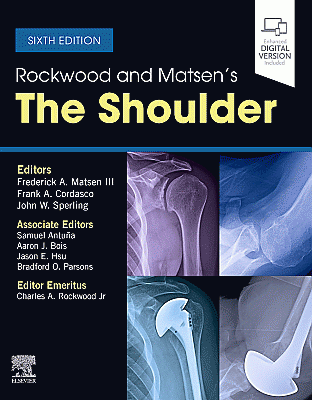



Rockwood and Matsen's The Shoulder. Edition: 6

-
Shipping info
Our publishing partner, Elsevier, maintains a flat fee for shipping. Books are delivered in the UK via DHL and will require a signature upon delivery.
The standard delivery time within the UK is 2 working days from the date of invoice.
Manufactured on demand titles (Availability: MD) take an extra 3-5 working days.
At this time we only ship Elsevier book orders to addresses within the UK.
Brexit: We have been informed that some couriers are now charging additional fees for importing from the UK into the EU. The customer is responsible for the payment of any import duties that are in addition to the shipping costs already charged.
-
Payment methods

PART I. Introduction
1. Opinion Editorial - What Should Be Our Teaching Legacy
PART II. Anatomy and Evaluation
2. Developmental Anatomy
3. Gross Anatomy of the Shoulder [ONLINE ONLY]
4. Clinical Evaluation of Shoulder Problems [ONLINE ONLY]
5. Radiographic Evaluation of Shoulder Problems [ONLINE ONLY]
PART III. Shoulder Conditions in Children
6. Shoulder Conditions in Children
PART IV. Shoulder Problems of Athletes
7. Throwing Athletes
8. Nonthrowing Athletes
9. Arthroscopic Surgery for Biceps-Labral Complex Disease
10. Tendon Tears in Athletes: Pectoralis Major, and Latissimus Dorsi and Teres Major
PART V. Shoulder Arthroscopy
11. Opinion Editorial - The Development of Shoulder Arthroscopy: Achieving a Paradigm Shift in Orthopedic Surgery
PART VI. Tumors of the Shoulder
12. Tumors and Related Conditions
PART VII. Fractures of the Scapula, Clavicle, and Humerus
PART VII. (PLACEHOLDER for previous edition figures)
Section A. Fractures
13. Fractures of the Scapula
14. Fractures of the Clavicle
15. Fractures of the Proximal Humerus
Section B. Expert Commentary
16. Opinion Editorial - Fractures of the Proximal Humerus
PART VIII: Shoulder Stiffness
17. General Principles of Shoulder Stiffness
18. Primary Idiopathic Shoulder Stiffness: Frozen Shoulder
19. Acquired Shoulder Stiffness
PART IX: Acromioclavicular and Sternoclavicular Joint Conditions
PART IX: (PLACEHOLDER for Previous Edition Figures)
Section A. Disorders of the Acromioclavicular Joint
20. Relevant Anatomy, Biomechanics, and Classification of AC Joint Disorders
21. Epidemiology, Clinical Presentation/Evaluation, Imaging, and Nonoperative Management of AC Joint Disorders (Atraumatic and Traumatic)
22. Open Management of Atraumatic and Traumatic Disorders of the AC Joint: Indications, Techniques, and Outcomes
23. Arthroscopic and Arthroscopic-Assisted Management of Atraumatic and Traumatic Disorders of the AC Joint: Indications, Techniques, and Outcomes
24. Complications Associated with Nonoperative and Operative Management
Section B. Disorders of the Sternoclavicular Joint
25. Relevant Anatomy, Biomechanics, and Classification of SC Joint Disorders
26. Epidemiology, Clinical Presentation/Evaluation, Imaging, and Nonoperative Management of SC Joint Disorders (Atraumatic and Traumatic)
27. Open Management of Atraumatic Disorders of the SC Joint: Indications, Techniques, Outcomes, and Complications
28. Arthroscopic and Arthroscopic-Assisted Management of Atraumatic Disorders of the SC Joint: Indications, Techniques, and Outcomes
29. Open Management of Traumatic Disorders of the SC Joint: Indications, Techniques, Outcomes, and Complications
PART X. Glenohumeral Instability
PART X. (PLACEHOLDER for Previous Edition Figures)
Section A. Anterior Instability
30. Anterior Instability - Epidemiology, History, PE, Imaging and Nonoperative Treatment
31. Anterior Instability - Arthroscopic Surgery and Outcomes
32. Anterior Instability - Open Surgery: Primary and Revision with Outcomes
33. Anterior Instability - Bone Augmentation Surgery: Primary and Revision with Outcomes
Section B. Posterior Instability
34. Posterior Instability - Epidemiology, History, Physical Examination, Imaging, and Nonoperative Treatment
35. Posterior Instability - Operative Technique and Surgical Outcomes
36. Posterior Instability - Open and Bone Augmentation Surgery
Section C. Multidirectional Instability
37. Multidirectional Instability - Epidemiology, History, Physical Examination, Imaging, and Nonoperative Treatment
38. Multidirectional Instability - Arthroscopic Treatment and Outcomes
39. Multidirectional Instability - Open Inferior Capsular Shift
40. Multidirectional Instability - Rehabilitation and Return to Sport
Section D. Expert Commentary
41. Opinion Editorial - Concavity Compression
42. Opinion Editorial - Glenohumeral Instability in the Young Patient
43. Opinion Editorial - First-Time Shoulder Dislocation: My Approach
44. Opinion Editorial - Use and Abuse of the Latarjet Procedure
45. Opinion Editorial - Soft Tissue Bankart: Still the Gold Standard to Me
PART XI: Sepsis
46. Sepsis Background
47. Molecular Mechanisms and Pathogenesis of Shoulder Sepsis
48. Clinical Management of Shoulder Sepsis
PART XII: Shoulder Ultrasound
49. The 13-Point Shoulder Examination
PART XIII. Rotator Cuff Lesions
PART XIII. (PLACEHOLDER for Previous Edition Figures)
Section A. The Rotator Cuff
50. Structure and Function of the Rotator Cuff
51. Epidemiology and Natural History of Rotator Cuff Disease
52. Evaluation of Rotator Cuff Pathology: History, Examination, and Imaging
53. Nonoperative Management of Rotator Cuff Disease
54. Rotator Cuff Repair: Tear Classification, Operative Techniques and Outcomes
55. Rehabilitation After Rotator Cuff Repair
56. Approach to the Irreparable Cuff Tear and Failed Cuff Repair
Section B. Expert Commentary
57. Opinion Editorial - Lessons Learned Treating Patients with Failed Rotator Cuff Repairs
PART XIV: Nerve Problems About the Shoulder
Section A. Nerve Problems
58. Nerve Problems Related to the Shoulder
Section B. Expert Commentary
59. Opinion Editorial - Paralysis and Nerve Injuries Around the Shoulder
PART XV: Glenohumeral Arthritis
Section A. Arthritis
60. Evaluation and Management of Glenohumeral Arthritis
61. The Role of Arthroscopy in the Evaluation and Management of Glenohumeral Arthritis
Section B. Expert Commentary
62. Opinion Editorial - Defining the Ideal Indications and Surgical Technique for an Anatomic TSA for Primary Osteoarthritis of the Shoulder
63. Opinion Editorial - Reconstructing the Glenoid in Total Shoulder Arthroplasty
64. Opinion Editorial - Bone Grafts in Shoulder Arthroplasty: What Is Their Role
65. Opinion Editorial - Trials and Tribulations of Bringing the Reverse to the United States
66. Opinion Editorial - Revision Shoulder Arthroplasty: Tips to Facilitate Component Removal and Reconstruction
PART XVI: Occupational Shoulder Problems
67. Occupational Shoulder Problems
PART XVII: Assessing the Effectiveness of Treatment
68. Assessing the Effectiveness of Treatment
PART XVIII. Concluding Remarks
69. Opinion Editorial - A Framework for Innovation in Shoulder Surgery
70. Opinion Editorial - Treating Patients with Shoulder Problems: Technique vs. Technology
Your Elsevier book orders are actioned within 48hrs during the working week. If any one item in your purchase is delayed we will send you what is in stock and will send on the remainder as soon as it arrives. This is provided at no additional shipping cost to you. Stock availability levels are updated on a daily basis. We ship directly from a UK warehouse.
Manufactured on demand titles (Availability: MD) take an extra 3-5 working days.
Shipping Costs
We currently maintain a flat fee structure for shipping book titles from Elsevier. Buy as many Elsevier titles as you like the we will still charge you the same single item shipping fee.
Overview Delivery Methods
Books are delivered in the UK via DHL and will require a signature upon delivery.
Deliveries within the UK
- The standard delivery time within the UK is 2 working days from the date of invoice.
- Print on demand titles take 3-5 working days.
Where is my order? Order Tracking
To find out more information about your order, select from the relevant options below:
Deliveries to the UK and UK shippers
Your order should be delivered to you/your shipper within 2-3 working days.
To track any deliveries using DPD, click here.
If your order is for a print on demand title, your delivery time will be longer, please allow an extra 3-5 working days.



